

Project Hail Mary [Review]
A few years back, one of my direct reports handed me a book with a look on their face that I can only describe as genuine concern for my cultural wellbeing. I had mentioned my love of sci-fi and my interest in getting back into reading, and when they asked if I had read Project Hail Mary and I said no, the look they gave me was the same one you might give someone who just said they had never heard of Star Wars. The next day, the book was physically placed in my hands with a firm instruction to read it.
I am glad they insisted.
Andy Weir's novel follows Ryland Grace, a middle school science teacher who wakes up from an induced coma aboard a spaceship, alone, roughly twelve light years from Earth, with almost no memory of how he got there. As his recollections slowly return, the full picture comes into focus, and it is a grim one. A microscopic organism called Astrophage has been quietly feeding on the sun, dimming it at a rate projected to cause a global temperature drop of 10 to 15 degrees. The downstream effects on weather patterns and food production put mankind on a clock measured in decades, not centuries. The solution, as desperate as it sounds, is to travel to Tau Ceti, the one nearby star that appears immune to Astrophage infestation, and figure out why. The mission is a one-way trip. That's the Hail Mary.
Grace begins that journey in solitude, his two fellow crew members having died during the coma induced for their long voyage. But the story takes its most compelling turn when he discovers another ship in orbit around Tau Ceti, piloted by a distinctly non-humanoid alien that Grace eventually names Rocky. What unfolds from that moment is one of the most genuinely moving explorations of first contact and cross-species friendship that science fiction has produced in a long time. Weir does not give Rocky a human face or human logic. He gives him curiosity, ingenuity, and a personality that earns your affection entirely on its own terms. The novel's second half is built on the friendship between these two beings trying to save their respective worlds, and it is quietly magnificent.
When I heard they were adapting it, I was cautiously skeptical. The Martian worked beautifully as a film because it was essentially one resourceful man against a hostile planet, and Ridley Scott knew exactly how to frame that kind of intimate survival story. Project Hail Mary presented a different set of challenges. The alien companion alone is a massive practical and creative gamble. An unconvincing Rocky would sink the whole enterprise. Then I heard Ryan Gosling was playing Ryland Grace, and something clicked into place.
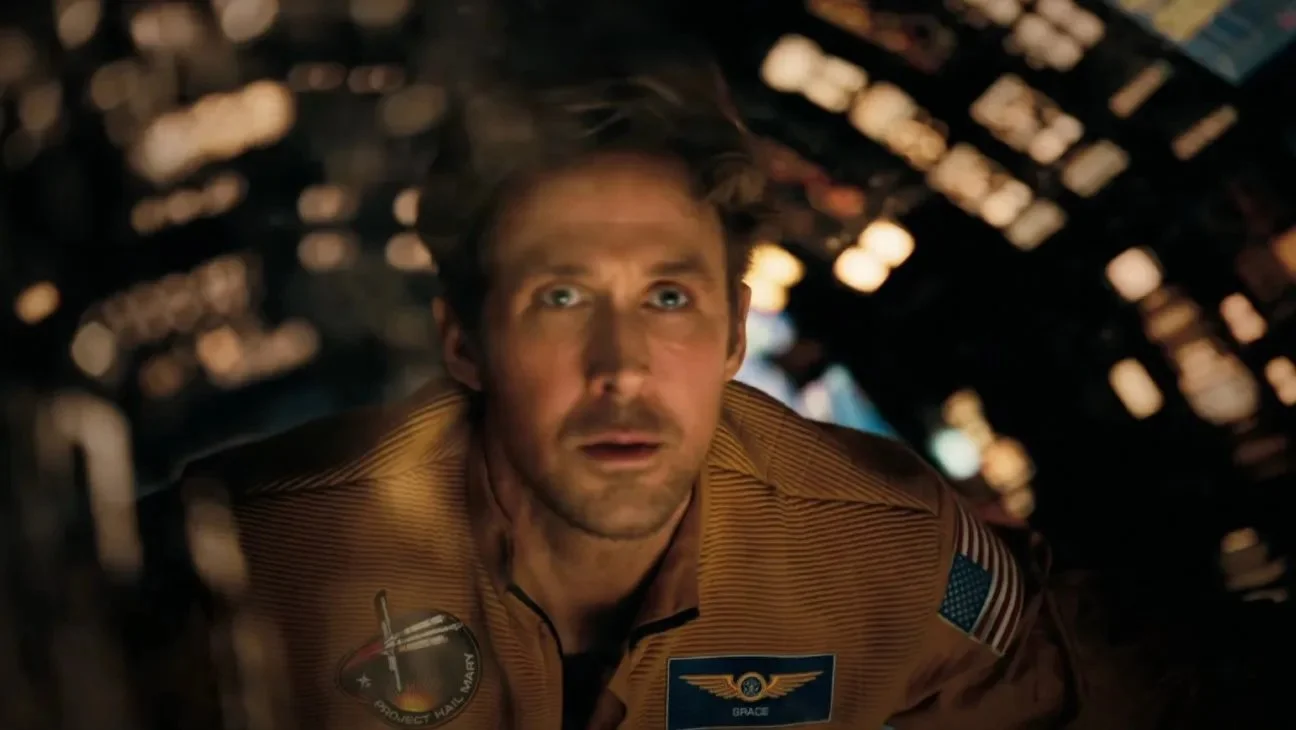
Gosling was the right call, and the film proves it without reservation. His particular gift as an actor is the ability to project warmth and humor in a way that never feels performed. He makes Grace feel like someone you actually know: a slightly self-deprecating, deeply curious, occasionally overwhelmed person who keeps solving problems because that is simply how he is wired. There are plenty of laugh-lines, and Gosling delivers them with the casual confidence of someone who is naturally funny rather than someone hitting comedic marks. But it is in the quieter moments, particularly the scenes where Grace is grappling with what he has been asked to sacrifice and what he is losing, where Gosling shows you exactly how good he is. His performance here reminds me of what made him so effective in First Man: the ability to carry enormous emotional weight without announcing it.
The film, directed by Phil Lord and Christopher Miller, handles the ensemble of Earth-bound characters with a sure hand. Grace's memories return in fragments, and through those flashbacks we meet the global team assembled to make Project Hail Mary a reality. Sandra Hüller is a revelation as Eva Stratt, the administrator with the authority to mobilize essentially any resource on the planet in service of this mission. Weir's Stratt on the page leans colder, more ruthlessly pragmatic. Hüller's version is something more interesting: someone who has buried her own fear and grief so thoroughly under the weight of her responsibility that you catch glimpses of the person underneath only in unguarded moments. It is a nuanced performance that brings genuine humanity to a character who could easily have read as a calculating bureaucrat.
And then there is Rocky. Built and performed by puppeteer James Ortiz and his team, with finishing work by the visual effects artists at Framestore, Rocky is the film's most audacious achievement. He has no face in any recognizable sense. He communicates through a complex series of tones that Grace gradually learns to interpret. And yet you will find yourself genuinely invested in him, genuinely amused by him, and in at least one scene I will not spoil, genuinely devastated for him. The blend of practical effects and CGI feels seamless in a way that big-budget creature work rarely does, and it means Rocky never becomes an abstraction. He is a presence. Several early reactions noted how stunned they were by how much they cared about a faceless alien, and that response is completely understandable once you have experienced it yourself.
What Lord and Miller understand, and what the best Weir adaptations capture, is that the humor in these stories is not decoration. It is survival mechanism, and it is philosophy. Weir is a writer who fundamentally believes that the most important tools anyone can have, facing impossible odds far from home, are accumulated knowledge, patience, curiosity, and the understanding that you need collaborators. Grace's jokes are how he stays sane. His willingness to ask for help is how he stays alive. The film never loses track of that.
The backdrop against which Project Hail Mary has arrived matters too. The premise is about as stark as disaster narratives get, a ticking clock extinction scenario with no cavalry coming. But the film threads it with so much genuine heart and wit that it functions as something close to a balm. Box office results seem to confirm that a lot of people needed exactly this. As of this writing, the film has grossed $81 million domestically and $141 million globally, making it the biggest release of 2026 so far and a record-setting opening for Amazon MGM Studios.
Rotten Tomatoes has the film sitting at 95% from critics, and I understand why. This is the kind of movie that used to feel more common than it does now: a big-budget genre film that trusts its audience enough to give them something to actually think about and feel, rather than just something to watch. It earns every laugh, every quiet moment, and every tear. If you have not read the book, you are in for an experience. If you have, you know exactly what they had to get right, and I am happy to tell you they got it right.
See it on the biggest screen you can find. And when it is over, you will probably be calculating how soon you can see it again.