Interview: ReelRank’s Tanner Jenkins Wants to Fix Online Movie Culture
Tanner Jenkins thinks online movie communities stopped serving movie fans. ReelRank is his attempt to build something better.
Founded by developer and film obsessive Tanner Jenkins, ReelRank is a new movie-focused platform attempting something far more ambitious than simply becoming another place to log what you watch. I first came across ReelRank last October during beta, signed up as a Pro Critic, and have spent the past several months watching the platform steadily evolve ahead of yesterday’s official V1 launch.
The idea behind ReelRank grew out of Tanner’s frustration with the current state of online movie communities. Rather than scattering different parts of online movie culture across separate platforms, ReelRank pulls everything together, letting users log films, build lists, stream movies directly through ReelRank Watch, contribute ratings, and participate in community discussion, all while feeding into a transparent scoring system that combines both user and professional critic perspectives. It’s also entirely ad-free.
“ReelRank will foster a movie community where users can express different and opposing opinions safely, have thoughtful conversations, and shape film discourse without ads or ragebait.”
I spoke with Tanner to better understand the philosophy behind the platform, the decisions shaping its design, and the kind of movie community he believes the internet has been missing. The interview is below, with minor edits for length and clarity.
ReelRank is officially out of beta! Check it out.
ReelRank
Getting to Know ReelRank
Sam Kahn, for The Geekly Grind (GG): For someone hearing about ReelRank for the first time, what is it?
Tanner Jenkins, for ReelRank (TJ): ReelRank is a movie community where you can read and write reviews, track what you watch, build custom lists, join discussions, and watch legally streamed free movies, all without ads. Pro Critic scores and user scores are both visible and broken down transparently, so you actually understand why a movie lands where it does. A lot of sites do two or three of those things. ReelRank does all of it in one place.
GG: What does actually using ReelRank look like right now? If I signed up today, what would I be doing first?
TJ: Before you sign up, you might already be browsing aggregated scores for a new release, reading through a Reel someone built around every Wes Anderson film, or watching a free movie on ReelRank Watch. When you do sign up, I’d start with your favorites list. Every movie page has a heart icon. Click it, then head to My Reels to drag and drop your ranking. From there, the platform opens up fast: log what you’ve watched, write a review, vote in a user poll, or scroll the Activity feed to see what other users are reviewing and saying right now.
GG: ReelRank combines professional critic scores and user scores into a single letter grade. How exactly does that system work, and what determines where a movie lands?
TJ: This is one of my favorite topics because the scoring method is one of the driving reasons ReelRank exists. I wanted more nuance in the data but more honesty in the aggregation. There are four data points: user recommendation percentage, user average score, Pro Critic recommendation percentage, and Pro Critic average score. Because each of those four data points bottoms out at 1 and tops out at 100, the final summed score runs from 4 to 400 before being translated into a letter grade.
For a movie to earn a particularly high or low grade, critics and users both have to agree. Take *28 Years Later: The Bone Temple*, which currently holds an ‘A++.’ That grade means critics and users are aligned that it’s a stellar film. If users were split in that example, I’d expect *Bone Temple* would be around a B. On every movie page, you can dig into the full breakdown: recommendation splits, averages, score distributions, and category ratings like writing, directing, and acting. In other words, the grade is the headline, but the data is always right behind it.
GG: ReelRank Watch lets users stream movies for free without leaving the site. What does that library look like right now, and what kinds of films can people expect to find there? The catalog seems heavily weighted toward older and independent films. Is that just the reality of licensing, or do you see that changing over time?
TJ: ReelRank Watch has over 500 movies in the catalog, with more added weekly. Your observation is accurate: the library skews toward independent, international, and older films. If you love cult B-movies, there’s a treasure trove here. I discovered *Nightbreed* through ReelRank Watch, which is exactly the kind of ’90s horror I grew up on, and I think other users will have similar experiences.
We also pick up newer titles when they become available, like I Saw the TV Glow, Bumblebee, and Sonic. The catalog is constrained by legal availability, but we add titles consistently and that number keeps climbing.
ReelRank Watch
The Why Behind It
GG: You’ve said this started as a joke with a childhood friend. When did it stop being a joke and become something you seriously wanted to build?
TJ: It was almost a game of ‘what next?’ I drew up designs in a notebook, then built a prototype. Once we had a general idea, the question became: what about data? I set up the database structure in Supabase and added Sinners as the first movie in the table. Then came the application itself, with GitHub auto-deploying to Vercel, all on the free tier at that stage. It was still just a way for me and my friend to trade ideas and tweak early designs. But the moment it became real was when I bought a domain from Porkbun and set up the DNS. That small cost made me realize I was actually, seriously making ReelRank.
GG: Letterboxd already has a massive userbase, strong community engagement, logging, lists, social discovery, and a film culture people genuinely care about. Then there’s Rotten Tomatoes and IMDb. If someone feels like those platforms already do everything they need, what’s the honest case for why ReelRank deserves space in that routine?
TJ: Those are all great communities that have their merits, but they only have a piece of the puzzle. If I write a lengthy, well-thought-out review on Letterboxd, it’s not going to affect the Tomatometer, obviously. I’d need to paste my review into Rotten Tomatoes as well, and even there, it only affects the Popcornmeter. On ReelRank, a user’s score affects the final aggregated grade. We also have movie discussions, which none of the big three offer. Only ReelRank brings reviews, aggregated scores, logging, discussions, and lists together in one place.
The big three each have their own flavor of community. Letterboxd tends to be more cinephile-focused, while IMDb and Rotten Tomatoes can feel more reactionary. ReelRank is built for both types of movie fans and more. We want to bring everyone together.
ReelRank Features Comparison
GG: ReelRank exists largely because you think platforms like Rotten Tomatoes, IMDb, and even Letterboxd lost something that originally made them valuable to movie fans. Do you think those platforms simply evolved in ways you disagreed with, or do you think commercialization inevitably pushed them away from what movie communities actually wanted?
TJ: It’s probably both. I can’t look at Rotten Tomatoes or IMDb and not feel like they’ve changed to better appeal to advertisers and investors. The user experience does not feel like the priority anymore. And I see similar pressures beginning to show in Letterboxd.
But my formative years as a movie fan were deeply tribal. If anyone on IMDb gave The Dark Knight less than a 9/10, I would have shoved them off a cliff. It’s fair to say ReelRank is a product of both how those platforms have changed and how I’ve changed as a movie lover.
GG: A lot of ReelRank reflects your own frustrations with how existing movie platforms evolved. Is there a risk that the platform ends up being optimized for the kind of movie fan you are, rather than a broader audience?
TJ: Yes, that risk exists, and it’s something I try to stay aware of. A lot of ReelRank’s features already come from beta users. For example, one user asked for the ability to leave no score and simply recommend or not recommend a movie. That led to the idea of supporting multiple scoring options, including four stars and letter grades.
ReelRank will always be influenced by what I think movie criticism should be, but as a product owner, I’m also beholden to the needs of the users. Without them, ReelRank is nothing.
ReelRank Reviews
Building It
GG: You had a working beta online within about a month of the original idea. What did that first version look like, and how different is it from what launches on June 22?
TJ: It’s night and day. The first version had about 30 recently released movies, a simple movie page with basic details, an input box for reviews, and a basic home page. Originally, there was a vertical reel of posters, with the highest-scored movies at the top. Hence, ReelRank.
Since then, there have been 18 major updates adding flagship features like discussions, logging, user awards, and more. There have also been two complete design overhauls. The June 22 V1 release is the biggest update yet. It includes a third design update, a WYSIWYG editor for reviews and discussions, a Letterboxd importer, dedicated review pages, and a host of quality-of-life updates. Literally every component and page from the first beta version has been completely rewritten and updated.
ReelRank Features and Scoring
GG: You’ve said the scoring system draws inspiration from Famitsu and from Ebert and Siskel’s thumbs-up, thumbs-down approach before translating everything into a 100-point scale. How did you arrive at that specific combination, and were there other systems you considered before landing there?
TJ: The interface around ReelRank has changed a lot, but the core scoring formula has stayed the same since the original joke about taking on Rotten Tomatoes over a year ago.
Famitsu was an influence because it takes four reviews and combines them into one clear result. A game getting 37 out of 40 from Famitsu has always meant more to me than a single 9 out of 10 from IGN, because there are multiple data points behind it. But there is also beauty in the simplicity of Siskel and Ebert’s thumbs up or thumbs down. Did you like it or not? Plain and simple. ReelRank does not imitate either system directly, but I tried to build something that carries the spirit of both: clear enough to understand quickly, but with enough data behind it to actually mean something.
Then the letter grade at the end, that’s all me. I wanted ReelRank to look visually different from Letterboxd, IMDb, Rotten Tomatoes, or Metacritic, all of which use some kind of decimal or percentage-based score. I think the letter grade gives ReelRank its own identity.
GG: A big part of ReelRank is making sure dissenting voices feel heard rather than drowned out. What design or moderation decisions have you made to stop unpopular opinions from simply disappearing once people start piling onto the majority view?
TJ: There are a few ways a user can have a voice on ReelRank. They can write reviews, create polls in the discussion board, build lists, or participate in conversations surfaced through the Activity feed. The Activity feed is intentionally light on algorithmic sorting. We are not pushing certain words, topics, or opinions. It mostly looks at how recent something is and how many wows or comments it has received, so the community is what gives content momentum. There is also the Agree-O-Meter, which lets you see how much you and another user agree, including specific reviews where you match or split.
But my favorite feature for dissenting voices is the Fair and Unfair voting on reviews. The question is not just “do I agree?” It is “was this review fair?” My hope is that someone can write a complete hit piece on *The Shawshank Redemption*, make their argument well, and still have other users say, “I disagree, but that was fair.” Right now we show top reviewers based on fairness data, but since I’m very data-driven, I’d eventually love to build a page or view that highlights reviews the community regards as fair even when they dissent from the broader consensus.
ReelRank Publisher Accounts and Mission
GG: Plenty of online platforms say they want healthy discussion, but the internet has a habit of rewarding outrage over nuance. What makes you think ReelRank can avoid eventually becoming driven by the same incentives?
TJ: I’d point again to the fairness feature. I’m not against someone writing a provocative review on ReelRank. If the community votes that the review is fair, it can still gain visibility. It should not be up to me to decide whether an unpopular opinion belongs on the platform or not.
I do, however, want to prevent bad actors. Something I’ve found most platforms are bad at is actually acting on their user policies. Once you start being lax on something like hate speech, you create an open invitation for bad actors. For example, ReelRank once had a new beta user with a Nazi symbol in their avatar. That user was banned immediately. When they made a new account and violated the policy again, I banned them again and blocked their IP. I haven’t had a problem since.
We also have a plan in place for if a movie gets brigaded. If a group of bad actors decides to review-bomb a movie because they don’t like the perceived politics of the film, ReelRank will take steps to temporarily limit those reviews’ visibility in the short term and reduce their weight in the long term.
GG: Is there anything in version one that still isn’t where you want it yet?
TJ: There are a lot of features I want to add: Top Critic status, a screenplay database, a movie poster database, built-in video reviews, and more. Those are still in the pipeline. But I was getting to a point in the beta where I had more features than users, and I’m more interested now in hearing from the community about what they want to see next from ReelRank.
ReelRank Discussions
The Community
GG: You’ve talked about Kay and Alejandro, two beta users who directly shaped parts of the platform. How much of what ReelRank is today came from user feedback versus your original vision?
TJ: V1 aligns pretty closely with the original vision on the surface, but a lot of the smaller, more nuanced features came from users. Alejandro pushed for the option to leave no score and simply recommend or not recommend a movie, which eventually led to custom scoring. Kay mentioned that the original light-only aesthetic was hard to see, and that led to dark mode, which eventually led to the first full design overhaul. Another user mentioned that it was hard to find other reviews or discussions, which led to the Activity feed. That is probably the biggest feature that was not part of the original design.
If I had to guess, I’d say around 60 percent of ReelRank V1 came from my head, and 40 percent came from users. As ReelRank grows, I would love it if that number flipped.
GG: You’ve been running the beta since May 2025, so there’s more than a year of real user activity behind this launch. Were there features you had to kill because they didn’t work, or ideas the community pushed back on harder than you expected?
TJ: I have not really killed any features, but if I could turn back time, I probably would not have created the Collection feature just yet. It is a great tool for tracking physical media, but I realized it was a more niche feature than most beta testers were interested in using at that stage. It is still there, and I stand by the work, but it took up more time than it was worth during the beta.
GG: ReelRank News feels like a deliberate part of the larger ecosystem you’re creating, which made me curious about the thinking behind it. Why was building that section important, what kind of content do you actually want living there, who decides what gets covered, and what kind of voice do you want ReelRank News developing over time?
TJ: There is both a vision and a practical reason for ReelRank News. The vision is pretty simple. I have gotten tired of movie news that chases clicks first and clarity second. ReelRank News follows a different set of rules: facts, not fast; clear, not clickbait; grounded, not gossip; concise, not cluttered. If we cover something, the headline should accurately reflect the story, the article should be useful, and the reader should not have to dig through five paragraphs of filler to get the point. There is also a practical side. ReelRank itself has some SEO limitations, so a closely related publication gives us another way to reach people who care about movies.
I want ReelRank News to include verified movie news, opinion pieces, editorials, release coverage, and film writing that fits the larger ReelRank ecosystem. Right now, coverage is guided by what feels relevant to movie fans and useful to the platform, but over time I would love to build an opinionated and diverse crew of writers who can bring different tastes and perspectives to it.
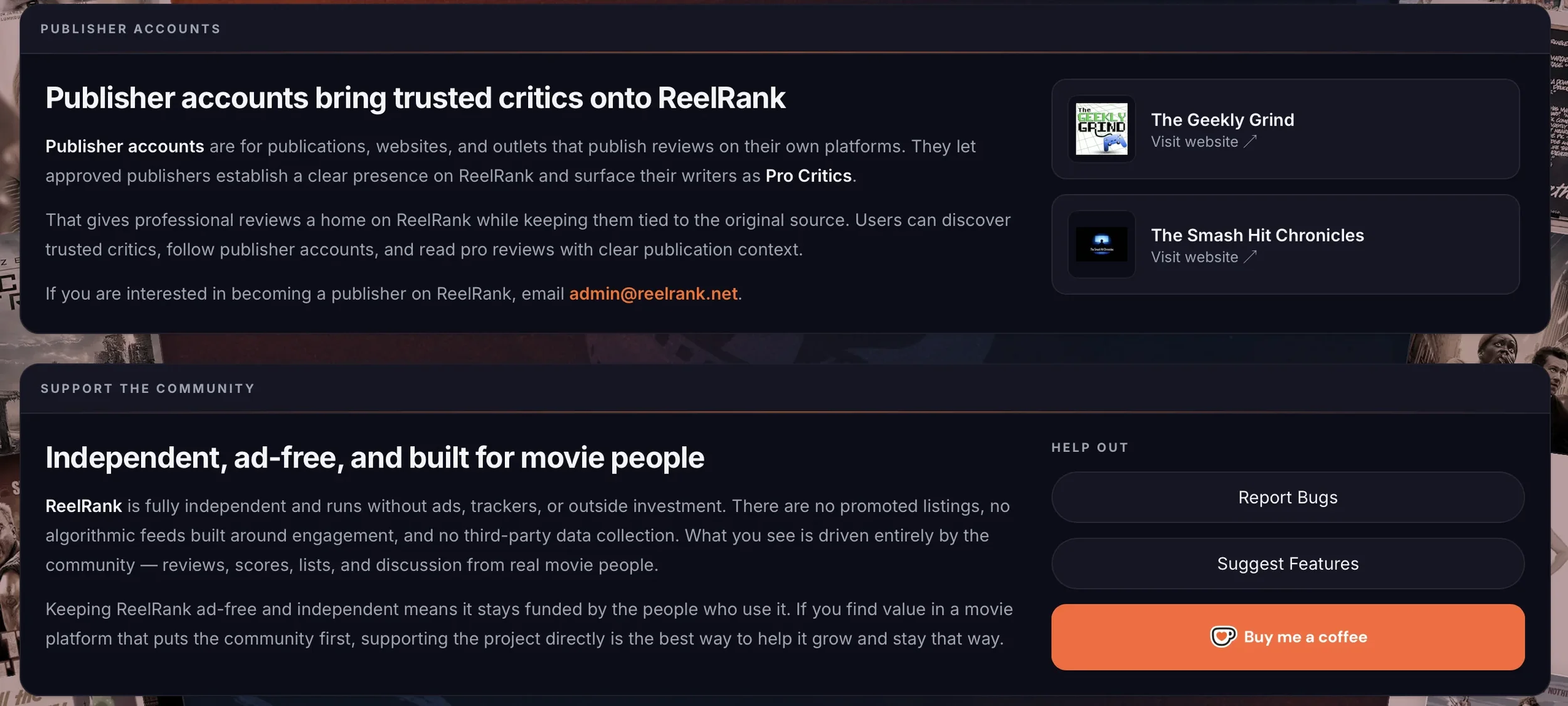
GG: Publisher accounts allow approved outlets to establish a Pro Critic presence on the platform. How does a publication actually qualify, and what does that vetting process look like?
TJ: ReelRank is meant to lift up smaller and independent voices, and that includes publisher accounts. The requirement is simple: you host your reviews on your own site or platform, and your reviews do not violate our user agreement. From there, approved publisher reviews can be added to the Pro Critic pool.
Since those publishers work with ReelRank directly, their reviews are prioritized above publicly available reviews we find ourselves. That means an approved publisher account can appear above major outlets like IGN or Roger Ebert. Eventually, I do see there being a more refined set of criteria, and maybe publisher tools or limits that require a subscription. But ReelRank will always be more accessible than Rotten Tomatoes, which has a very high standard that even established publications can struggle to meet.
GG: ReelRank News and publisher accounts suggest you want this to become a real criticism platform, not just another place where people talk about movies. As that side of the platform grows, who decides what criticism gets elevated, and how do you avoid recreating the same gatekeeping structures that have historically defined professional criticism?
TJ: Ideally, elevation will always be driven by the ReelRank community. One of the first features I want to add after launch is Top Critic status. That status would be earned through a minimum number of Fair votes and by maintaining a high fairness percentage.
Top Critics would include both regular users and Pro Critics, and they would be treated by the same standard. A RogerEbert.com critic like Robert Daniels would be held to the same standard as a ReelRank user like Tectash. And because ReelRank already tracks fairness data, we can use that foundation to help surface newer users who are not as established yet, including giving early Fair votes more weight so strong criticism has a real chance to be seen.
ReelRank News
The Business
GG: You’re launching as a free platform, with no ads, no paid tier, and free movie streaming built directly into the site. That’s an expensive proposition. So beyond how ReelRank plans to sustain itself financially, how do you convince people this is a platform worth investing time into if they can’t be sure it’ll still be here years from now?
TJ: The honest answer is that ReelRank is built to be cheap to run before it is built to make money. There are ideas for how ReelRank could eventually pay for itself through user patronage, paid publisher features, API services, and tasteful sponsorships. I think ReelRank is still years away from any of that, and that approach only works if the platform stays cost-efficient. I’ve made design decisions around ReelRank with that in mind.
For example, the movie database is in-house. It takes a lot of time and effort to add movies that way, and it would have been much easier to use TMDb’s API. But if I had gone that route, the second ReelRank started taking money, I’d need to deal with commercial licensing. Another example is image storage, which is my largest expense. As much as I’d like to add a full database of poster variants, the storage cost would triple per movie at a minimum. That is all to say the cost to run ReelRank is very low, and it has been built to be sustainable for a long time. The user base could grow 300-fold tomorrow and the cost would not change.
The Launch
GG: Community platforms live or die on network effects, and ReelRank is unusually transparent about where it currently stands. Anyone landing on the homepage can immediately see the user count and activity levels. Was that transparency a deliberate decision, and how are you thinking about growth from here?
TJ: Completely deliberate. I can’t in good faith say I’m building a community for users and then hide the data that shows how the community is doing. ReelRank is built around transparency, so that should apply to the platform itself too: user counts, activity levels, reviews, discussions, all of it. I’d also love to keep adding new community data points based on what users actually want to see.
Growth from here is about getting the word out and making it easy for people to give ReelRank a real chance. I’ve heard from multiple people that they’re too ingrained in Letterboxd to try something new, which is exactly why V1 includes a Letterboxd importer. The goal is not to convince anyone to switch overnight. It’s to remove friction, give movie fans a reason to try ReelRank, and build the kind of community that makes them want to stick around.
GG: Getting people to change habits is hard. A year from now, what tells you people haven’t simply adopted another movie platform, but are actually building the kind of movie community you believed was missing in the first place?
TJ: The biggest mark of success would be seeing users praise each other for what they contributed. Not just “ReelRank has reviews,” or “ReelRank has lists,” but users saying someone wrote a great review, built a great Reel, started a great discussion, or helped them see a movie differently.
That is when ReelRank becomes more than another movie site. A year from now, if people are recognizing each other’s taste, arguments, recommendations, and effort, then the community is actually working. The goal is not just activity. The goal is a place where movie fans make each other’s experience better.
ReelRank Reels
Final Thoughts
GG: You’ve spent more than a year building ReelRank around a pretty specific idea of what online movie communities should look like. If this works the way you hope it does, what do you think online film culture gets back that you believe it’s missing right now?
TJ: I hope online film culture gets back more patience with each other. Not everyone is going to agree on a movie, and they shouldn’t. Some of the best conversations come from disagreement. But I think we have lost some of the ability to disagree with curiosity instead of contempt.
One of the reasons I built ReelRank is because I think movies should bring people together. If ReelRank works the way I hope it does, it gives people a more transparent and civil place to talk about movies. You can see where scores come from, understand why people feel differently, and make your case without the whole thing turning into a shouting match. If we can help people connect through movies instead of dividing over them, I think that would be a success.
ReelRank is officially out of beta! Check it out.






Fright Train walks a tightrope between the methodical tension of survival horror and the constant pressure of a roguelite.