All You Need Is Kill (2025) [Review]
Few modern science fiction stories have proven as adaptable or as resilient as All You Need Is Kill, originally written by Hiroshi Sakurazaka and illustrated by Yoshitoshi Abe. Since its debut, the story has lived multiple lives, most famously through the manga adaptation by Takeshi Obata and the Hollywood blockbuster Edge of Tomorrow, starring Tom Cruise. Each version has reinterpreted the same core loop, death, repetition, and growth through failure, through a different cultural and stylistic lens. The legacy alone makes Kenichiro Akimoto and Yukinori Nakamura’s 2025 anime adaptation an intriguing proposition.
What initially drew me in, beyond simple curiosity, was the promise of a markedly different visual identity. This is not an adaptation content to coast on the familiarity of powered armor and battlefield spectacle. From its earliest trailers, Akimoto’s take signaled a willingness to be strange, abrasive, and stylized in ways that felt closer to experimental anime cinema than to mainstream sci-fi action.
The premise remains largely intact. An alien entity known as Darol arrives on Earth and does nothing. For nearly a full year, it stands inert, an impossible structure quietly reshaping the planet around it. On the anniversary of its arrival, Darol awakens, unleashing a wave of monstrous creatures and threatening humanity with extinction. The story centers on Rita, an independent and emotionally guarded young woman who joins a volunteer organization tasked with preventing Darol’s spreading roots from overtaking major population centers.
Shortly after Darol’s awakening, a critical incident traps Rita in a time loop. She is forced to relive the same day repeatedly, dying in brutal and often sudden ways as the invasion escalates. The structure evokes a violent, psychedelic spin on Groundhog Day, where each reset strips away any illusion of safety. Memory becomes Rita’s only continuity, isolating her from everyone around her who resets along with the world.
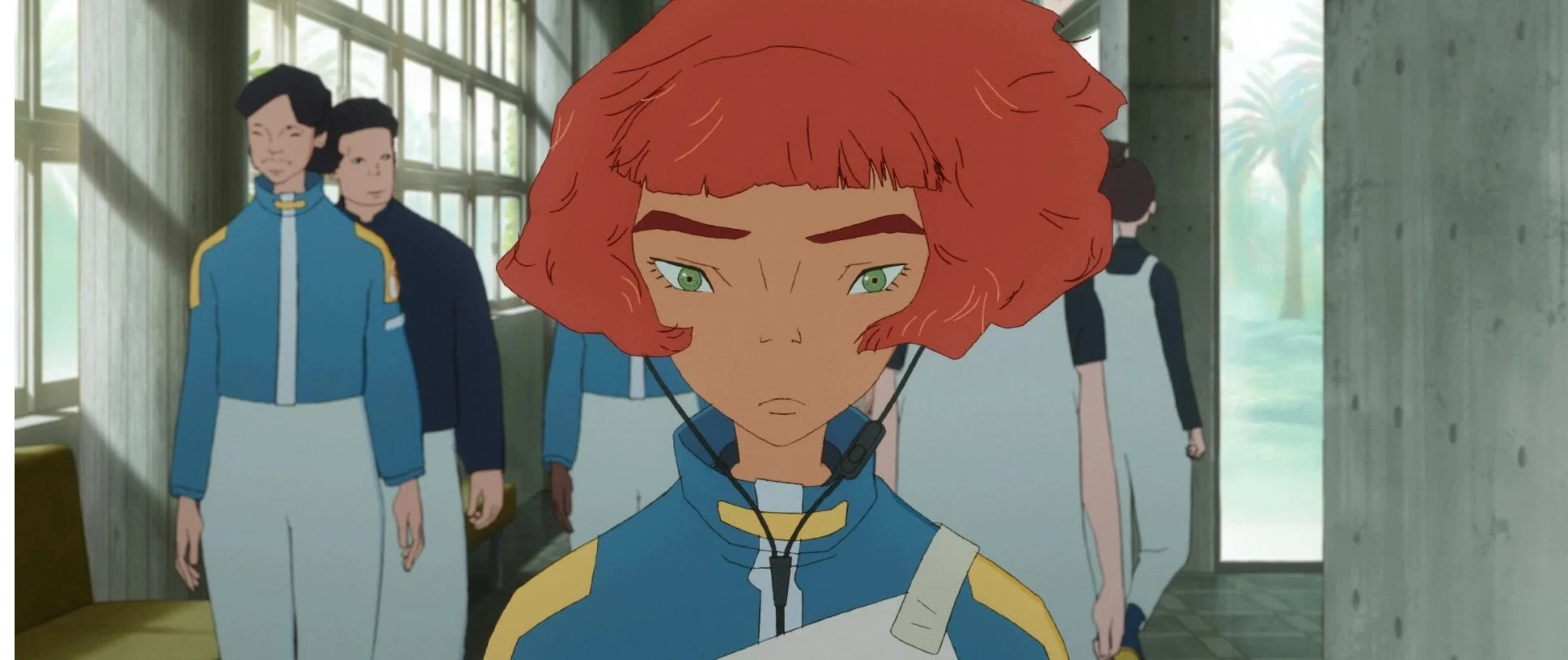
As the loops continue, the film shifts into its training and adaptation phase. Rita learns to pilot the mechanized “Jacket” used to traverse Darol’s hostile terrain, gradually mastering its movement and combat systems. She experiments with different weapons to determine what can actually put the monsters down. Early attempts end quickly and often, but repetition breeds competence, and competence breeds survival. After a couple mysterious “resets”, and inexplicable improvements to her Jacket and weaponry from one attempt to the next, Keiji emerges as a crucial emotional counterweight. The revelation that he, too, is experiencing the time loop fundamentally alters the story’s trajectory. Until this point, Rita’s survival strategy has been rooted in isolation. She treats others as disposable variables in a repeating equation. Keiji’s shared awareness fractures that worldview. Their mutual recognition creates a rare sense of kinship, one built on shared memory and shared trauma. Over time, this connection begins to chip away at Rita’s stoic, isolationist tendencies, reintroducing the idea that progress may require trust, not just skill.
From an analytical standpoint, the plot itself remains relatively straightforward outside of the looping structure. Where Akimoto and Nakamura’s adaptation distinguishes itself is in its characterization of Rita. Her strained relationship with her mother and her disengaged outlook prior to Darol’s arrival provide a compelling emotional baseline. This version leans into the psychological cost of repetition, reinforcing the story’s long-standing themes: growth through failure, isolation versus human connection, and the crushing weight of memory when no one else remembers what you have lost. Her relationship with Keiji follows a similar (but still charming) arc, with genuine moments of self-revelation and growth between the two nestled in the death-ridden hours they shared together.
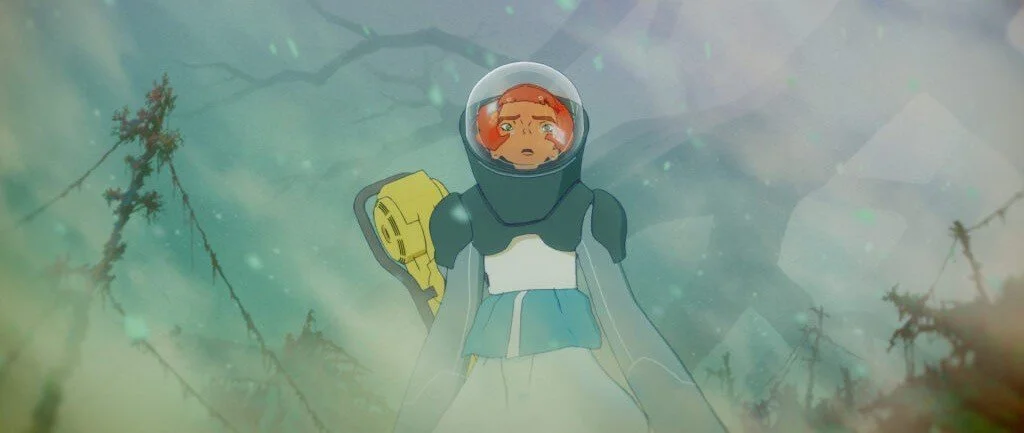
Visually, this adaptation will be divisive. Character models can appear underbaked or intentionally rough, lacking the polish associated with big-budget anime films. Faces skew angular and expressions occasionally feel stiff. Yet these rough edges are offset by crisp, kinetic action sequences and environments drenched in bold, often surreal color palettes. Darol itself feels alien in a way that resists easy readability, and combat scenes embrace chaos without sacrificing spatial clarity.
Context also matters. The past six months have been exceptionally strong for anime films, with theatrical releases like Demon Slayer Infinity Castle, Chainsaw Man: The Reze Arc, and Jujutsu Kaisen Execution continuing to normalize anime as an event-level cinematic experience. Against that backdrop, All You Need Is Kill may not match the visual grandeur of Demon Slayer or land its emotional conclusion quite as cleanly as Chainsaw Man’s Reze arc, but it still earns its place.
Ultimately, Akimoto’s adaptation succeeds not by outshining its predecessors, but by reframing them. It is a harsher, stranger, and more introspective take on a familiar loop, one that reinforces why this story continues to resonate within the sci-fi canon. It may not be flawless, but it is absolutely worth the trip to the theater.
![All You Need Is Kill (2025) [Review]](https://images.squarespace-cdn.com/content/v1/6371c1aaf44e9e0252208a01/1768629458976-BSBMVOKO89OFB1G3YU1G/AYNIK1.jpeg)
![Sentenced to Be a Hero - Episode 1 [Review]](https://images.squarespace-cdn.com/content/v1/6371c1aaf44e9e0252208a01/1767767225203-INLQCVZ3LSMRAO9YC6RS/STBAH2.jpeg)
![Chainsaw Man: The Reze Arc [Review]](https://images.squarespace-cdn.com/content/v1/6371c1aaf44e9e0252208a01/1761607207004-84TTTW0XIFBBFYGNZM4X/IMG_1940.jpeg)
![Demon Slayer: Infinity Castle Part One [Review]](https://images.squarespace-cdn.com/content/v1/6371c1aaf44e9e0252208a01/1758252678830-M274MDWN92BDAP0BA40O/demon-slayer-kimetsu-no-yaiba-infinity-castle.jpg)
![Solo Leveling - Episode 18 [Review]](https://images.squarespace-cdn.com/content/v1/6371c1aaf44e9e0252208a01/1739125853541-G7CGJK4OX8KHNRHNUA96/solo-leveling-season-2-episode-6-jinwoo-kargalgan.png)
![Solo Leveling - Episode 17 [Review]](https://images.squarespace-cdn.com/content/v1/6371c1aaf44e9e0252208a01/1739124481443-08KPANY80R744VAYHXUS/official-solo-leveling-episode-17-season-2-episode-5-this-v0-an0mm8ex9pfe1.jpg)
![Solo Leveling - Episode 16 [Review]](https://images.squarespace-cdn.com/content/v1/6371c1aaf44e9e0252208a01/1739123736898-IEYM20GDTZ90MISEUD7T/official-solo-leveling-episode-16-season-2-episode-4-i-need-v0-ZWJhN2E4ajFyd2VlMcHS_ku2I8pl-9Wtgwn1m9gP-2wGpu8BmdWfi6vXjCAM.png)
![Sakamoto Days: Episodes 1-2 [Review]](https://images.squarespace-cdn.com/content/v1/6371c1aaf44e9e0252208a01/1737423116367-VM71FXPCFX34Q0QOLXAC/anime-sakamoto-days-1.jpeg)