Mina the Hollower [Review]
Yacht Club Games strikes gold again
After the resounding success of Shovel Knight, there's a version of this story where Yacht Club Games could have become a footnote: a scrappy indie studio hits it out of the park with their debut title, spends years releasing expansions and spinoffs, and eventually fades into the background as the games industry moves on without them.
That's not what happened.
Instead, Yacht Club took the long road, trusted their instincts, and delivered Mina the Hollower, a game that doesn't just remind you why you loved Shovel Knight, but announces with full confidence that this studio has another iconic franchise on their hands.
The wait was real: Shovel Knight launched over 10 years ago (2014!) and became one of the defining indie games of its era, a love letter to the NES golden age that understood its influences deeply enough to transcend them. What followed was years of expansions, campaigns, and a Shovel Knight universe that kept growing. All of that was genuinely great. But Mina the Hollower is something different: it's Yacht Club stepping fully into their next chapter, and the result is one of the best-reviewed games of the year on Metacritic. We're happy to add our 10/10 to that conversation.
The World of Tenebrous Isle
Mina is a genius mouse inventor and a member of the Hollowers, a researcher guild dedicated to studying the earth and its resources. Years before the game begins, she and her wealthy patron Baron Lionel created six Spark Generators across Tenebrous Isle, massive towers that provided the island's communities with the power to grow and flourish. Mina eventually departed to conduct research abroad while Lionel stayed behind to watch over the people, building up the city of Ossex as a hub of civilization on the isle.
When Mina gets a letter from Lionel summoning her back, the situation sounds urgent. The Spark Generators have malfunctioned for unknown reasons, chaos has seemingly taken hold, and before she can even finish reading the letter, a massive kraken attacks her ship. She washes ashore, fights her way through burning buildings and hostile guards, and finally reaches Ossex, only to find Lionel cutting a ribbon at an orphanage opening, remarkably relaxed about the whole thing. She also learns that Thorne, the former head of the Baron's guard, has gone rogue and taken those loyal enough to sabotage the generators. But why?
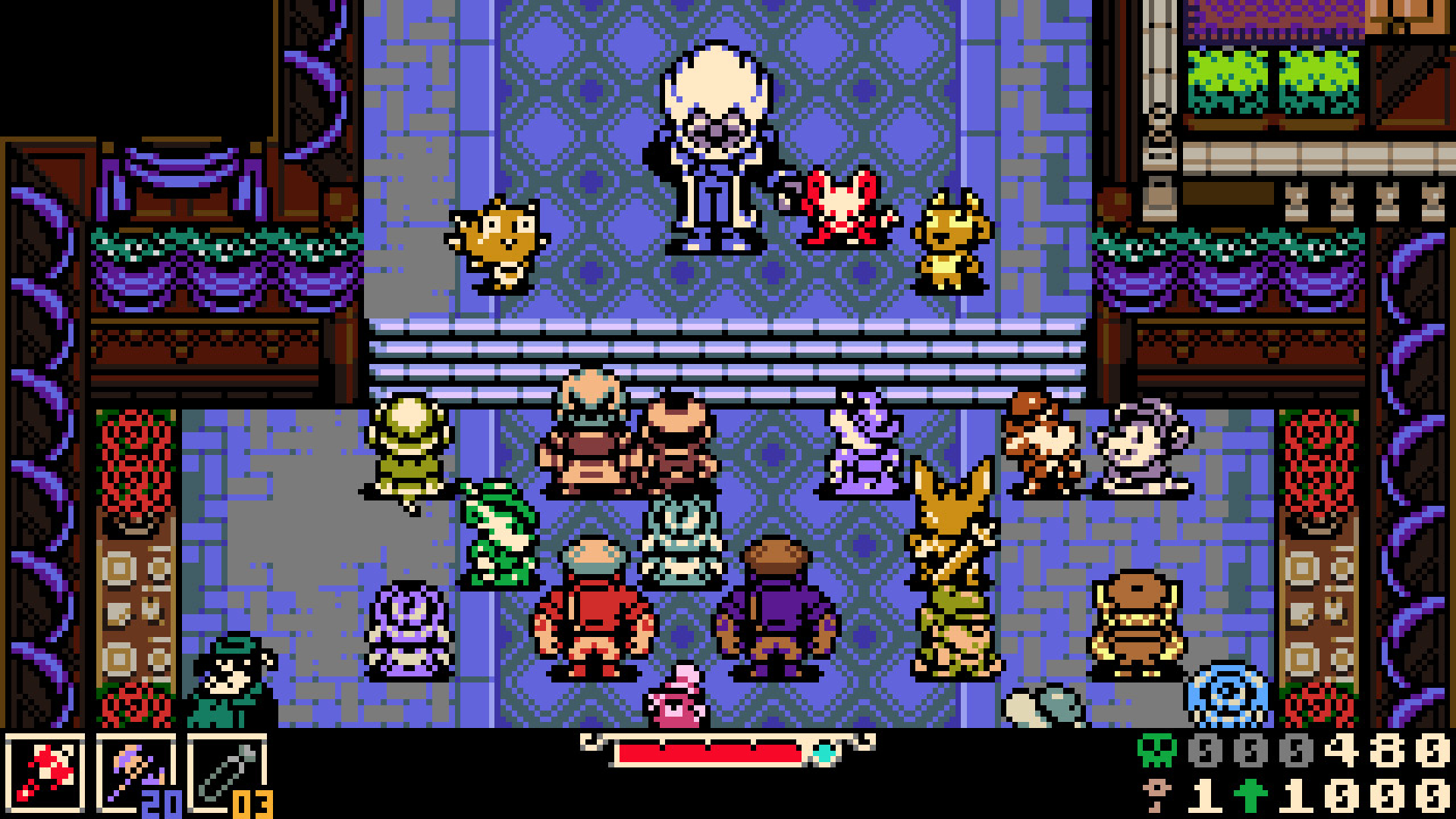
The story is relatively straightforward in its structure, but it's the cast surrounding Mina that makes Tenebrous Isle feel genuinely worth exploring. Rhene, a fox and one of Mina's friends from the Hollower's Guild, is a fun and helpful companion, while fellow guild member Muriel makes an immediate impression by yelling "IT'S HOLLOWIN TIME!" directly into your face upon meeting her. Even minor NPCs have personality to spare, and the preexisting relationships Mina has with the island's residents give every interaction a little more texture and weight.
A (Retro) Feast for the Eyes and Ears
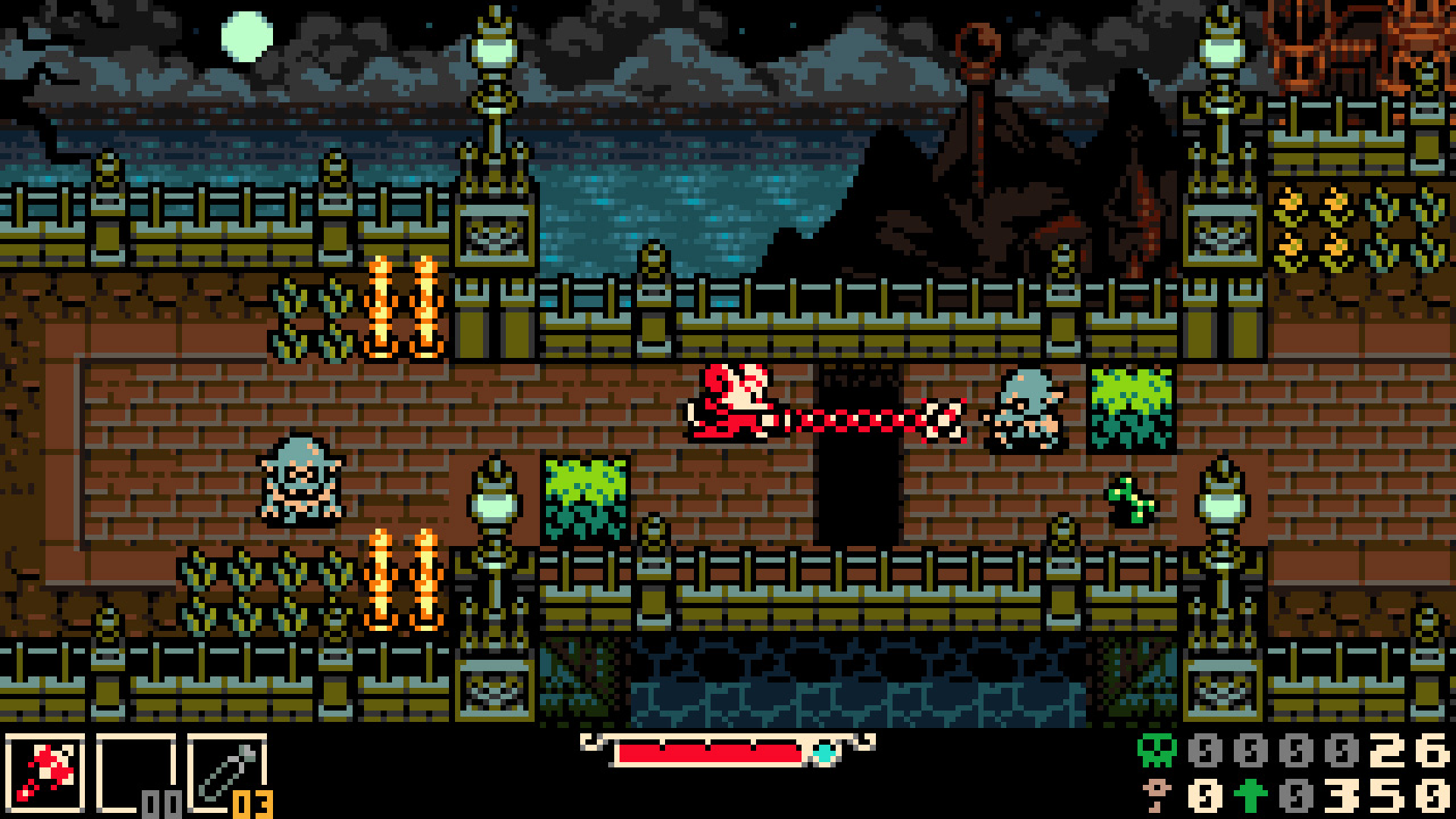
Aesthetically, Mina the Hollower lands somewhere between the warmth of a classic Nintendo console and the more colorful, expressive worlds that came alive on the Game Boy Advance. Presented in a modern context, that foundation gets layered with gorgeous environmental detail: machines in the background hiccup and bounce, mysterious liquids bubble in their pools, and nearly every screen has something happening in the margins that rewards a second look. It's pixelated glory in the truest sense - not a cheap nostalgia grab, but a genuine realization of what that art style can achieve when a talented team takes it seriously. The soundtrack is equally charming, and the sound design earns its place right alongside it.
The Gameplay Loop
This is where Mina the Hollower really stakes its claim. From the opening moments, you're asked to make a foundational choice: do you want to work fast and close with twin daggers, keep your distance and master range with a whip, or bring the house down with a massive hammer? It's a decision that echoes something most of us felt as kids standing in a Pokémon Center for the first time, because each weapon genuinely changes how the moment-to-moment game feels. The hammer rewards patience and timing, letting you chain dodge rolls into a devastating charged swing. The whip demands spatial awareness and positioning. The daggers encourage mobility, getting in fast, dealing damage in bursts, and getting back out before you take a hit. Additional weapons open up as the game progresses, and a robust sidearm system layers in spinning daggers, axes, and more, giving you real options for building a combat style that fits how you like to play.
The signature move in Mina's toolkit is the burrow, which is exactly what her title as a Hollower refers to. She can dive underground, travel quickly, and surface again, with a brief window of invincibility while beneath the surface and a slightly extended jump when she pops back up. There's a learning curve here, particularly around the moment of vulnerability before she goes under and the timing needed to maximize that exit jump. But once it clicks, burrowing becomes deeply satisfying, both as a traversal tool and as a way to weave through combat encounters that would otherwise punish you hard. Complementing this is a healing system that borrows from Bloodborne's philosophy: taking damage doesn't just drain you, it gives you the opportunity to fight back and reclaim what you've lost. Aggressive play in lower-health situations is rewarded, which keeps the risk-reward loop feeling alive in a way that purely defensive strategies never quite replicate.
Bones, Sparks, and Dying with Dignity
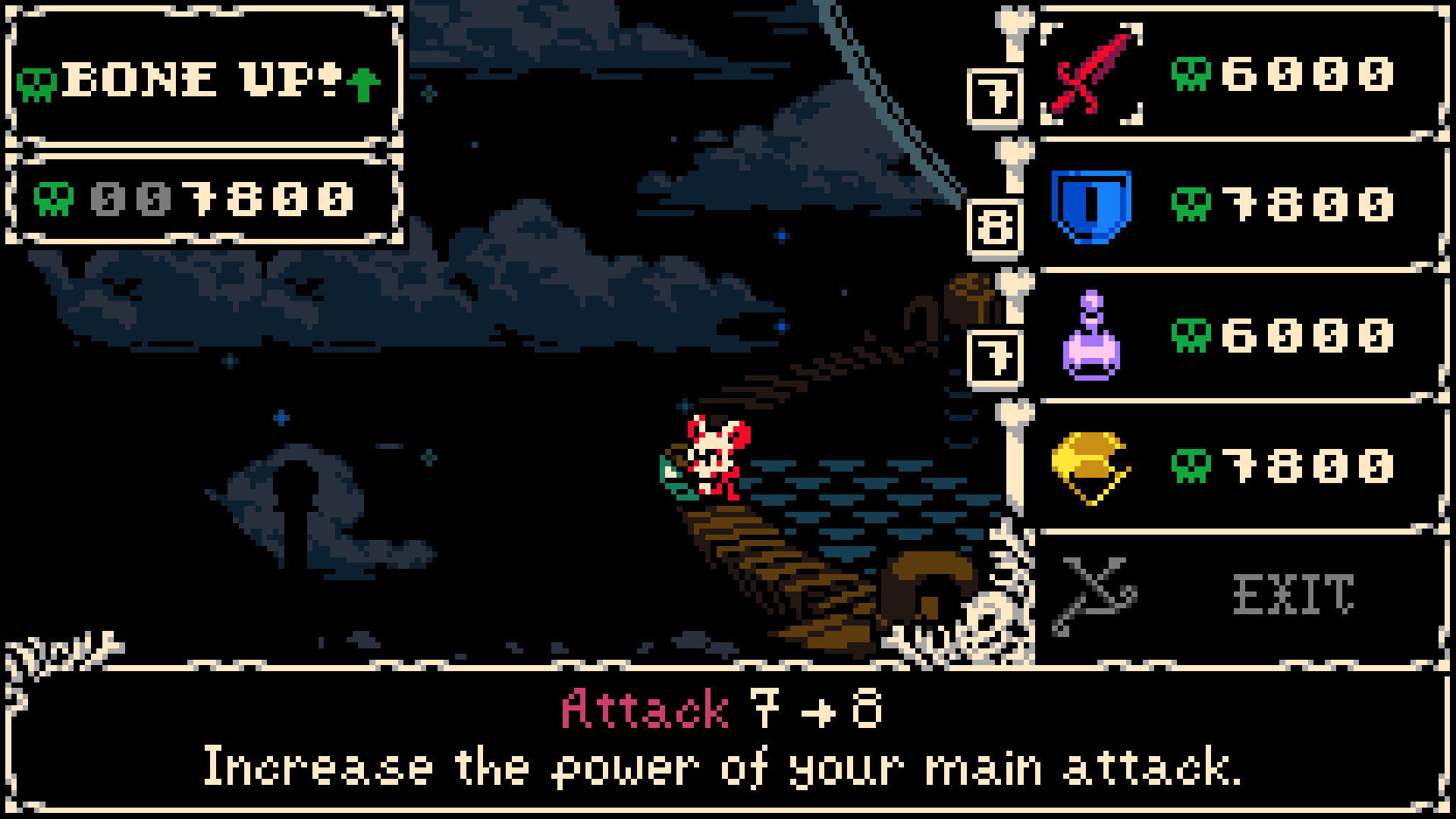
As Mina defeats enemies across Tenebrous Isle, they drop bones, the game's primary currency for growth. Accumulate enough and you can "bone up," raising your attack, defense, or sidearm damage by a level, or you can bank those bones into a Bonestone for safekeeping. That decision matters, because Mina the Hollower borrows from the Souls playbook in a way that feels earned rather than derivative. Die once and you lose your spark, which now resides in whatever killed you or near the spot where you fell. Die again before recovering it, and any unbanked bones are gone for good. Your gained levels stay with you, which keeps the loss from feeling catastrophic, but the sting of a big bone haul vanishing is real. As the game progresses you can unlock additional sparks, giving you a bit more room to breathe before the losses compound, and you will need that grace.
This is a challenging game. There are some screens where I couldn’t help but wonder who had hurt whoever designed that particular segment (nothing like platforming and dodging projectiles at the same time!) But Yacht Club has done something clever here: they've built in a suite of accessibility options that function like a modern-day Game Genie. You can disable damage entirely, remove the bone loss mechanic, add more save points, or dial the difficulty down in whatever combination works for you. You can also go the other direction and take double or triple damage, slow your base movement to force more burrowing, and generally make an already demanding experience even more demanding. The purists who would rather those options not exist are going to find them easy enough to ignore. Everyone else gets a game tuned to their own preferences, and that's a feature, not a compromise.
A World Built to Be Explored
One of the most consistently rewarding aspects of Mina the Hollower is its emphasis on exploration. The island of Tenebrous is fully accessible from the onset of the game, with only later dungeons gated by certain events, leaving Mina free to explore any area in any order. While that openness is sometimes punishing in the difficulty (you may find yourself in an area with mobs that are especially painful to dispatch), there are also big ways in which it pays off. Hidden rooms are tucked behind walls that look like dead ends, burrow spots lead to entire side dungeons that the main path never requires you to find…not to mention trinkets, bones, and alternate sidearms that are scattered throughout in a way that makes thorough exploration genuinely feel like it's worth your time rather than a compulsive checklist.
The Verdict
Expected playtime sits between 25 and 30 hours, but with the variety of builds, the breadth of hidden content, and the various feats waiting to be unlocked, devoted players are likely to clock 50 to 70 hours or more in this world. And the entire package costs?
$20
Twenty. Dollars.
If the value proposition alone doesn't stagger you a little, consider what Yacht Club has delivered: a fully realized action-adventure with Souls-adjacent combat depth, the kind of vibrant pixel art that makes screenshots look like boxed SNES cartridge art, a charming cast of characters, and a world that rewards curiosity at every turn.
Shovel Knight made Yacht Club Games a name worth knowing. Mina the Hollower makes them a studio worth watching with the same sustained attention most of us reserve for the biggest players in the industry. They've done it again. More than that, they've done something new. That's rarer than it sounds.
Mina the Hollower
Yacht Club Games follows up their legendary debut with a new icon: a richly layered action-adventure that earns every one of its comparisons to the Souls genre while wrapping it all in some of the most joyful pixel art you'll see all year.