Absolute Batman #20-22 [Review]
Scarecrow breaks Bruce down, Harley's origin changes everything, and Jack Grimm proves the scariest Joker is the one who owns the city.
Twenty-two issues in, Absolute Batman still refuses to coast. Scott Snyder and Nick Dragotta have spent nearly two years dismantling everything we thought was load-bearing in the Batman mythos and rebuilding it into something meaner, stranger, and somehow more human. The latest stretch of issues, #20 through #22, might be the most psychologically brutal run of the series yet. If you fell behind, this is your catch-up. Fair warning: spoilers ahead for all three issues.
The Straw Man Tightens His Grip
The engine driving this arc is the Absolute Universe's Scarecrow, and he is a genuinely different animal from any version of Jonathan Crane we've seen before. There's no fear toxin here, no gas mask gimmick, just a harrowing face and psychological torment with surgical precision. This Scarecrow simply appears where he shouldn't be able to, says exactly the thing that will hurt the most, and vanishes. He doesn't spread fear so much as dread - a slow rot that settles into a person and stays. Snyder has always been good at making Gotham feel haunted…this is the first time the haunting has a face.
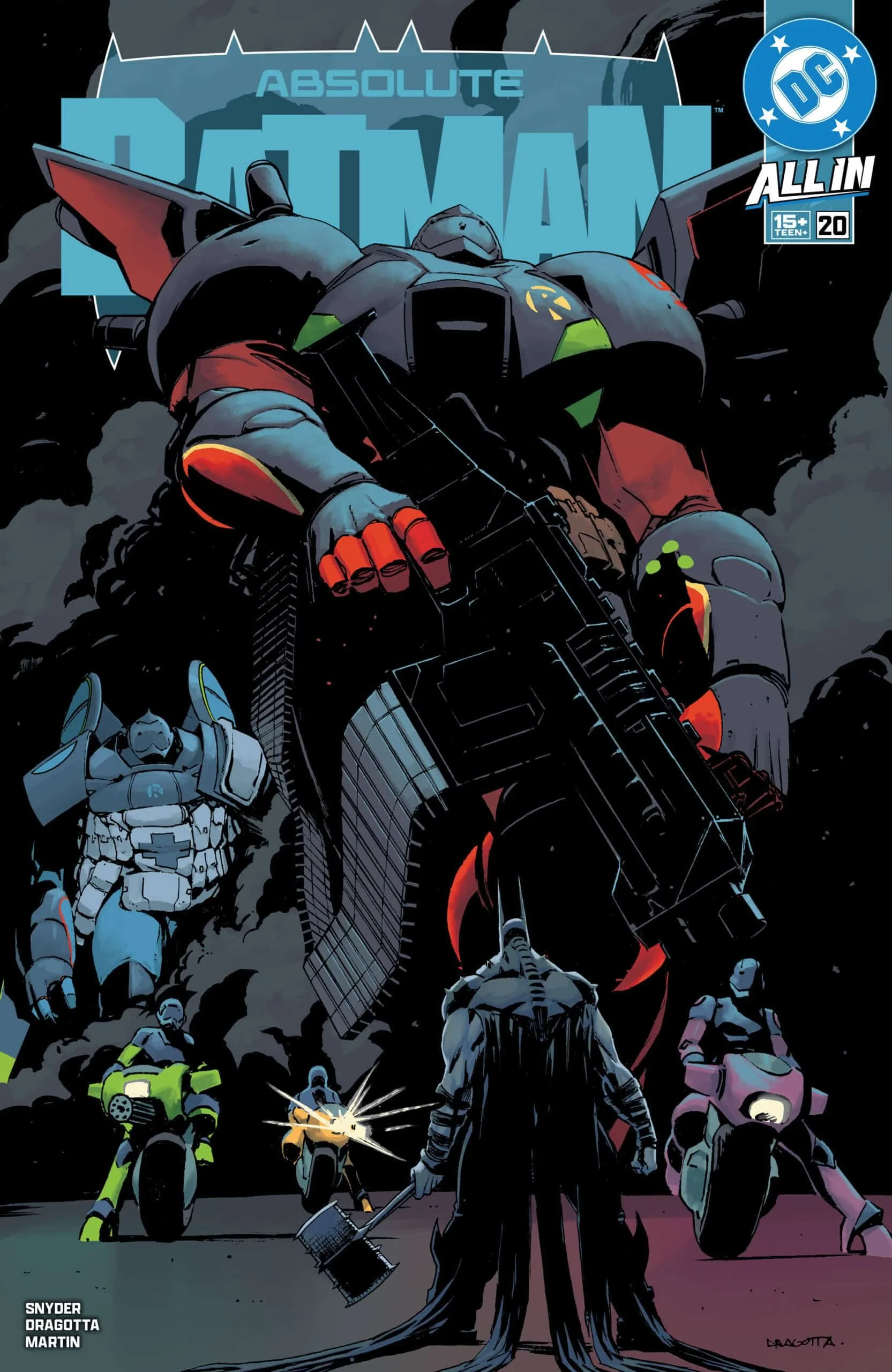
Issue #20 opens with Bruce at his lowest point since the series began. Jim Gordon is dead, the city believes Batman killed him, and Bruce has walled himself off from Alfred and Harley to chase the conspiracy he's been piecing together from stolen files. That chase leads him back to Blackgate, the same prison where he once did time, to confront Joe Chill about whether his entire life was engineered. The sequence that follows is the best of the issue. A lighter flares in the darkness of Chill's cell, and Scarecrow is just there, impossibly, waiting. What he tells Bruce is poison delivered with a smile: Bruce wasn't some grand project. He was a joke shared between Jack Grimm and Crane. After all, what's the natural prey of an owl? Then comes the twist of the knife, the claim that Martha Wayne belonged to the Court of Owls, and before Bruce can even process it, Scarecrow goads Chill into taking his own life right in front of him. Bruce crashes through a wall in pursuit and lands face to face with the Robins.
That cliffhanger pays off immediately in #21, and Dragotta gets to flex in a completely different register. The Robins here aren't sidekicks. They're a paramilitary youth squad in massive mech suits, recruited and radicalized by Grimm's operation, with Deathstroke barking orders in their ears while Alfred and Harley coach Bruce through his. Watching this hulking, brawling Batman spend as much energy containing collateral damage as he does fighting five armored teenagers is the kind of spectacle only this book delivers, a full-scale mecha battle staged with the confidence of a creative team that knows exactly how absurd and exactly how serious it wants to be. The smart wrinkle is Dick Grayson. He's the oldest of the group, an EMT, and the only one visibly uncomfortable with the violence Slade keeps demanding. Snyder plants that seed quietly and moves on, but if I were a betting man, I’d say it's going to matter sooner rather than later.
The issue breathes between punches, too. Gordon's funeral gives Gotham's grief real weight and gives Barbara a scene confronting the Robins that pushes her further down her own road. Bruce's old friends, the men who will apparently become this world's Riddler, Penguin, Two-Face, and Croc, keep drifting toward their worst selves in check-ins that read like a slow-motion tragedy. Then the final pages arrive, and the series delivers the meeting it has been circling for months: Bruce and Jack Grimm, face to face, on the steel skeleton of a construction site.
Jack Grimm and the Great Inversion
Amidst the various tweaks that Snyder and Dragotta have made to the Batman legend, the development of Grimm as Joker is the boldest idea in the entire Absolute line. Snyder wrote what many of us consider the definitive modern Joker across Death of the Family and Endgame, a cackling force of nature. Grimm is the opposite instrument. He's a billionaire. He's composed. He doesn't need to blow up a hospital when he can buy the hospital, the police contract, and the news cycle covering both. He funds the Robins, he deploys Deathstroke, and Scarecrow moves through Gotham like an extension of his will. The rogues' gallery isn't a collection of rivals in this universe: It's Joker’s portfolio.
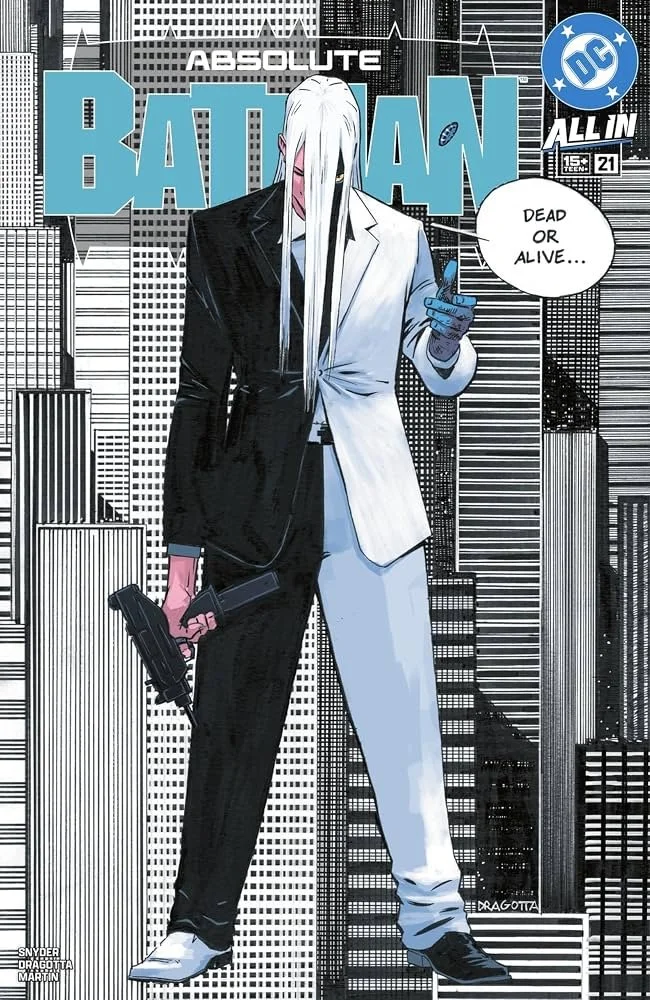
And that's the whole thesis of Absolute Batman in miniature. Snyder has flipped the power structure of the mythos. Bruce Wayne has no fortune, no butler-staffed manor, no cave full of vehicles. He's a working-class engineer running a resistance out of borrowed spaces with a spy posing as an ally, the teenage leader of the Red Hood Gang, and a shrinking circle of friends being actively converted into his future enemies. The classic dynamic, an establishment billionaire hero versus an anarchist clown, has been inverted into an oligarch clown versus a scrappy vigilante of the people. For anyone who grew up when Batman's wealth was simply part of the furniture, the inversion is (not so) quietly radical. It makes Batman an underdog again, maybe for the first time in decades, and it makes the Joker frightening in a way that feels uncomfortably current.
The construction site scene crystallizes it. Grimm tells Bruce, calmly, that he is the one who decides when Batman ends, and that he isn't finished with him yet. It's not a threat shouted across a chemical vat - more like a landlord reminding a tenant who owns the building.
The Crooked House
Then #22 goes and becomes my favorite issue of the arc. Werther Dell'Edera, the artist behind Something Is Killing the Children, steps in for a Harley Quinn spotlight, and his scratchy, childlike-then-monstrous style is a perfect match for what Snyder is doing. While Bruce and Harley flee through Gotham with the Robins hunting them and riot police flooding the streets, Harley finally tells Bruce her story, whether he wants to hear it or not.
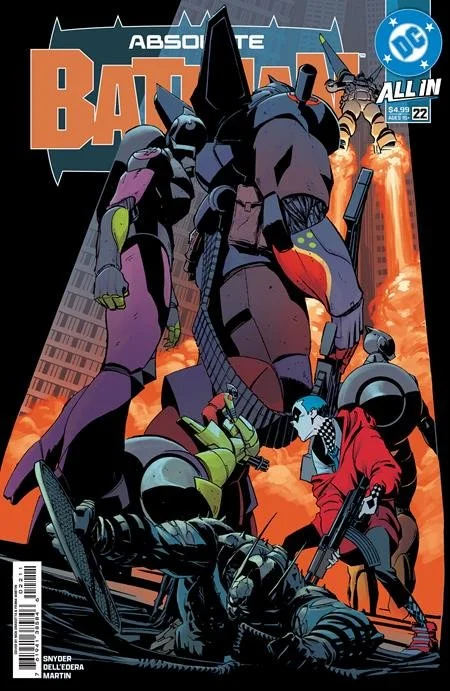
And what a story. We see young Harleen in a crooked little house, drawing pictures of the shadow that looms over it, while her mother, the woman who will become this universe's Dr. Arkham, slides from resisting Grimm's project to serving it. The body horror lurking beneath that house is some of the most unsettling imagery the series has produced, and Dell'Edera renders childhood terror with a specificity that got under my skin. The issue's closing revelation reframes everything: Harley appears to be Jack Grimm's daughter. She hasn't been an ally who wandered into this war. She was born inside it, and she's been trying to warn Bruce away because she knows precisely what her father does to people.
Bruce, meanwhile, can't stop moving forward. Scarecrow's needling about his past drives him to the one act that can't be walked back: opening his father's coffin. It's empty. And Scarecrow's claim, that Thomas Wayne is alive after all these years, lands like a wrecking ball whether or not it's true. That's the elegance of a Scarecrow without fear toxin. We have no mechanism to hide behind, no way to wave the reveal off as hallucination. Neither does Bruce. The doubt is the weapon.
A Franchise That Keeps Earning It
All of this is happening while Absolute Batman continues to be the commercial engine of the entire industry. The first issue is deep into double-digit printings, the variant market around the book has helped reignite the collector scene, and the Absolute line it launched has reshaped DC's publishing strategy. Success at that scale usually breeds caution. This book responds by killing Jim Gordon, hollowing out Bruce's origin, and handing an issue to a guest artist for a Harley horror story.
Now it's officially jumping mediums. At Annecy in late June, Warner Bros. Animation and DC Studios announced an adult animated Absolute Batman series with Snyder himself as showrunner and Dragotta producing, alongside a separate Joker anime, Laugh Riot. Snyder has already said the goal is to make the show feel like the comic come to life, expanding the first arc's connective tissue rather than reinventing it. Keeping the original creative team at the wheel is the single best sign this adaptation could stick the landing.
Two years ago, "what if Bruce Wayne was broke" sounded like an elevator pitch with a short shelf life. Issues #20 through #22 prove the opposite. The premise wasn't the point. The point was rebuilding Batman as someone who can actually lose, in a Gotham owned by the people he's fighting, and then testing him with a villain who attacks the only thing this Bruce has left: his certainty about who he is. The Straw Man arc is the series operating at full power, and if the show captures even half of this energy, DC has another decade of this universe ahead of it.
Absolute Batman 20-22
Absolute Batman #20-22 delivers the series at its most psychologically merciless, with Scarecrow dismantling Bruce's certainty about his own origin while Jack Grimm tightens his grip on Gotham from above.