A Mischief of Magpies - Issue 1 [Review]
The Wandering City is calling, and this stunning first issue makes it impossible not to answer.
Coda fans, rejoice! The creative team of Si Spurrier and Matias Bergara returns with A Mischief of Magpies #1, the new DSTLRY series with colors by Bergara and Kike J. Díaz and letters from Hassan Otsmane-Elhaou. The team behind Coda and Step By Bloody Step has always had a knack for fantasy with a human pulse, and this opening chapter puts that pulse front and center.
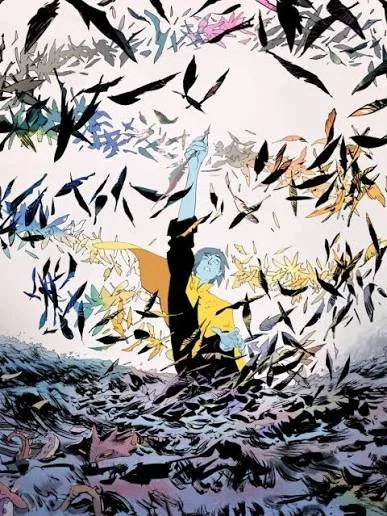
It starts with dreams. Marinus Picknett, Mar to the few people who bother to know him, has always had trouble being able to tell where his dreams end. As a six-year-old, his crayon diary records a monster he "sore" in his sleep. We see a twelve-year-old's school assignment about dream journals turns into something more unsettling, an account of falling asleep on a bad day and falling somewhere else entirely. There is water in these dreams: a churn under the beach…a throbbing engine in the ocean. By the time the story reaches its full stride, Mar is sixteen, and the boundary he could never quite locate reveals itself completely. He finds he is not dreaming at all. He is simply falling out of his world and into a different one.
He eventually discovers that he’s landed upon the Wandering City, a colossal machine-metropolis crossing a shoreless ocean. It is a city of two halves. Above the waves, gilded spires and striped-suited citizens who greet Mar as the Visitor, a chosen protector whose arrival is cause for celebration. Below, twilight halls where something with far too many teeth waits in the dark, the Moray King, whose hungers press up against everything the city holds in the light. In between, clowning along a rusted beach, a mischief of magpies (cue Leonardo DiCaprio meme) who chatter, steal, invent games, and seem to know more than they let on.
Sixteen is the perfect age for the protagonist of this story, and Spurrier knows it. Mar is old enough to understand exactly how bad things are at home and young enough to be powerless to fix any of it. His younger sister Milly is seriously ill, his parents are fraying under hospital trips and a strained marriage, and school offers him bullies and invisibility in roughly equal measure. He is carrying an adult's awareness with a kid's standing, which is the specific misery of being a teenager that fiction can struggle to execute well. When the city's ticker-tape voice spells out its offer, the list reads like an inventory of everything a sixteen-year-old aches for: escape from the humdrum, adventure, the respect of those you save, and above all the knowledge that you are seen, valued, worth something. Anyone who spent a hard stretch of their teens retreating into wondrous worlds like Hyrule or Middle-earth because the real world felt like it had no room for them will recognize this kid immediately. It is familiar territory in the best sense: the lonely-child-finds-another-world tradition of The NeverEnding Story, but aged up and told with an honesty about why kids need those other worlds that keeps it from feeling like reheated soup.
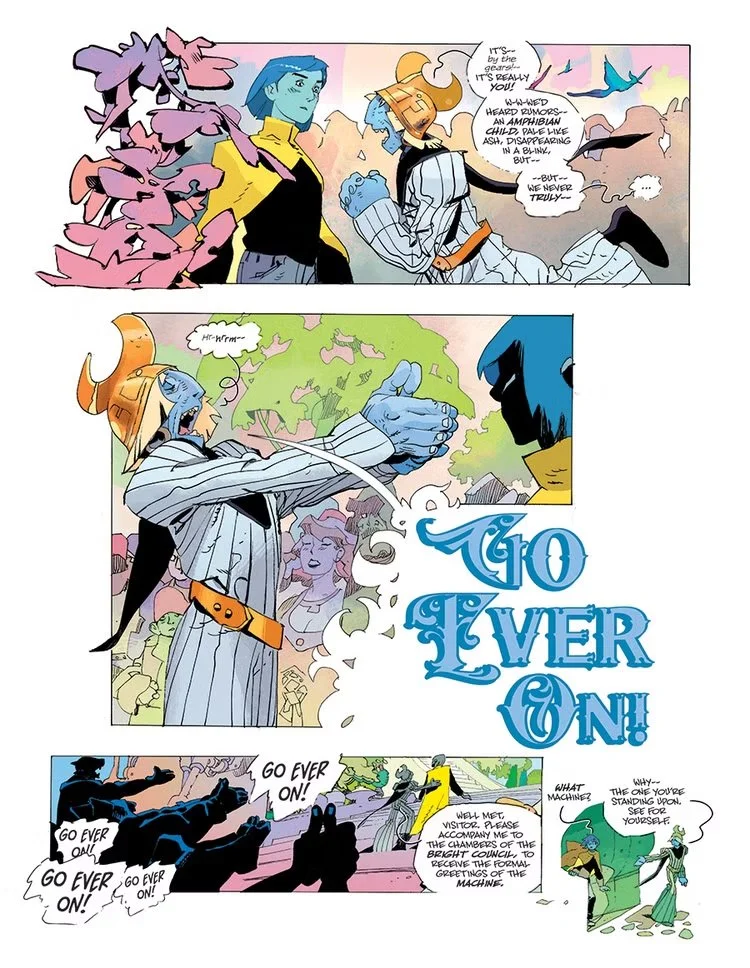
The construction is where the issue takes its biggest swings. Long stretches are told through Mar's own journals, and the book ages with him, from phonetic kindergarten scrawl through careful preteen cursive and on toward the guarded, self-conscious voice of a teenager who has learned to keep the strange stuff to himself. Panels are collaged into the pages like photos taped into a scrapbook. The journals do double duty, charting Mar's growth while letting the family's troubles accumulate at the edges, a new baby here, a hospital trip there, all filtered through the limits of what he understands at each age. Otsmane-Elhaou's lettering carries a real share of the load, giving the diaries, the magpies' frantic chatter, and the city's mechanical ticker-tape each a distinct voice. The format asks for patience, and readers wanting a breezy twenty minutes may bounce off it, but the density rewards the effort.
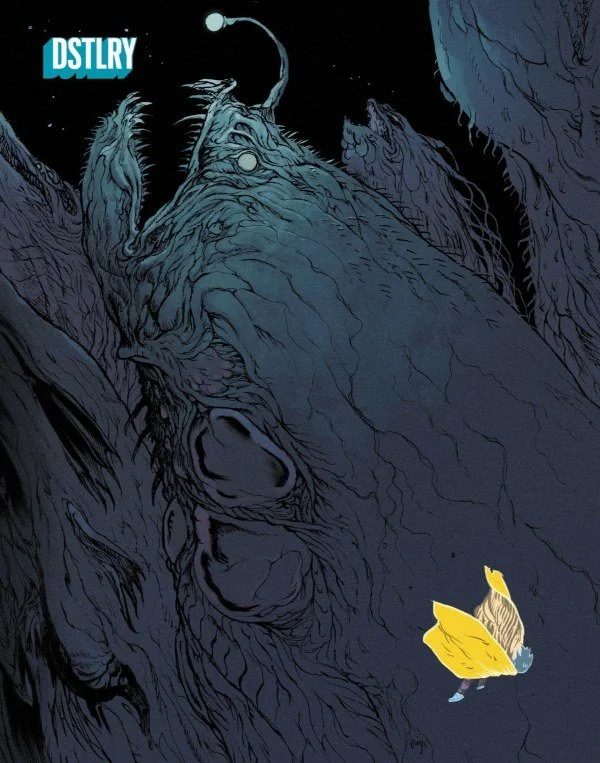
Bergara's art makes the two worlds feel like different emotional temperatures. Mar's waking life sits in muted greys and blues, his yellow raincoat the one defiant spot of warmth, and that same yellow becomes a beacon when he descends toward the Moray King's domain, a small bright figure against inky blacks and bruised purples. The double-page reveal of the Wandering City is the standout, an impossible tower of pipes, spires, and treads rising out of watercolor storm clouds, busy with airships and balloons. You understand on a purely visual level why Mar keeps going back. The fantasy world is saturated and alive. Home is not.
What I am most curious about is where this goes. The first issue plants questions it wisely leaves alone: whether the city is real, what the magpies actually know, what being the Visitor will demand of Mar, and what happens to a family already stretched thin when their son keeps disappearing. There is also a harder question humming underneath, which is what a story this honest about escapism eventually has to say about coming back, especially for a sixteen-year-old standing at the edge of adulthood with one foot already out the door. A Mischief of Magpies #1 is a strong, confident opening built on a premise almost anyone can feel in their bones. I want to see what Spurrier and Bergara do with it, and that anticipation is exactly what a first issue should leave behind.
A Mischief of Magpies - Issue 1
A Mischief of Magpies #1 splits its heart between a boy's crumbling home life and the fantastical city that needs him, and refuses to let either half feel less real. It is a gorgeous, formally ambitious debut that earns every ounce of its ambition.